Table of Contents
ToggleBuilding an outdoor kitchen transforms how you use your backyard, and Home Depot outdoor kitchens make the process far less daunting than it once was. Whether you’re a weekend griller or someone who dreams of entertaining outdoors, Home Depot stocks everything from complete modular systems to individual appliances and structural materials. This guide walks you through the essentials: what Home Depot offers, how to plan your layout, what to budget, and when to call a professional. By the end, you’ll have a clear path to a functional outdoor kitchen that actually fits your space and lifestyle.
Key Takeaways
- Home Depot outdoor kitchens offer flexible options at multiple price points, from $2,500 modular islands to custom-built systems costing $8,000–$20,000+, ensuring solutions for any budget.
- Plan your outdoor kitchen layout by sketching a work triangle between prep, cooking, and serving areas, and verify local building codes for setback requirements from combustibles before purchasing materials.
- Pre-built modular kitchens provide quick installation in a day but limit customization, while individual components from Home Depot allow custom designs that fit your exact space and workflow.
- Hire professionals for gas or electrical rough-in, structural work, concrete foundations, and permit coordination to ensure code compliance and avoid costly mistakes.
- Invest in quality materials and proper foundation work upfront—a well-built outdoor kitchen outlasts bargain alternatives by years and maintains its resale value.
- Home Depot staff specializing in outdoor living can guide you through code requirements and recommend vetted contractors, reducing the risk of expensive errors.
Why Choose Home Depot for Your Outdoor Kitchen Project
Home Depot stands out as a one-stop source for outdoor kitchens because you can source everything, from weatherproof cabinetry to built-in grills to the concrete pad underneath. The retailer carries multiple price tiers, so a homeowner on a $3,000 budget and one with $15,000 can both find viable options.
More importantly, Home Depot staff who specialize in outdoor living can guide you through code-related questions (like setbacks from property lines or gas line routing in some areas) and help you avoid costly mistakes. Many stores also offer installation services or can recommend vetted local contractors. The return policy and warranty support matter too, outdoor equipment faces sun, moisture, and temperature swings that break down inferior products quickly. Buying quality materials upfront, even if more expensive, typically outlasts bargain alternatives by years.
Outdoor Kitchen Options and Product Categories at Home Depot
Pre-Built Modular Kitchens
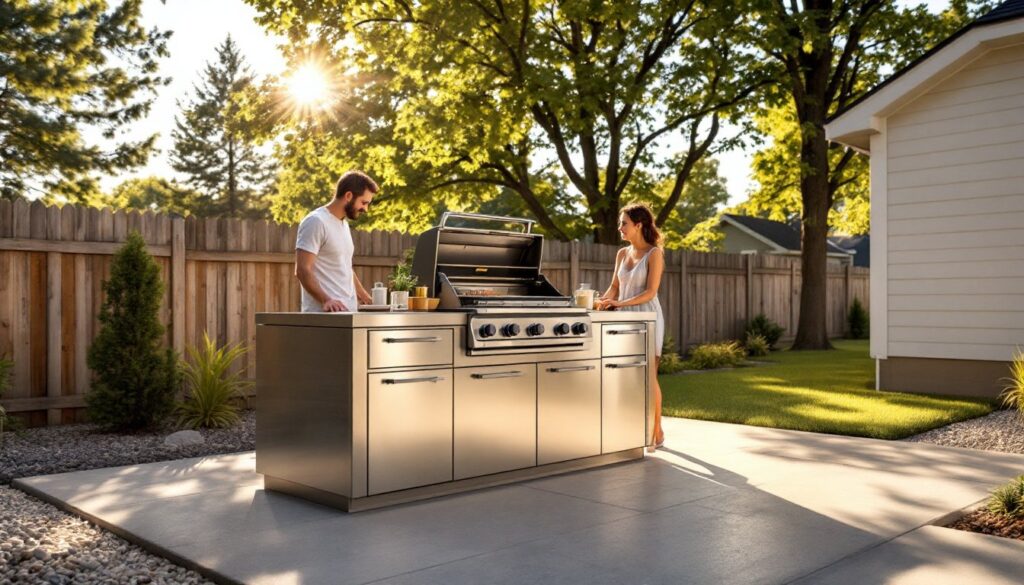
If you want a turnkey solution, Home Depot stocks modular outdoor kitchen islands that bundle a grill, side burner, storage, and a countertop into one unit. These typically range from 3 to 6 feet wide and come in stainless steel, powder-coated aluminum, or composite materials. Most sit on a base that requires a level, compacted gravel foundation (or a poured concrete pad for maximum stability).
The advantage is speed: delivery, positioning, and basic hookup can happen in a day. The trade-off is flexibility, you’re limited to the footprint and appliance combo the manufacturer chose. They’re also heavier than you’d expect: moving a 400-pound island requires two people and a dolly, or professional installation.
Individual Components and Appliances
For true customization, buy appliances and cabinetry separately. Home Depot carries built-in grills (gas or charcoal), side burners, smoker boxes, refrigerator drawers, and storage cabinets rated for outdoor use. You can also source countertop materials like granite, tile, or composite stone, plus structural framing: pressure-treated lumber, galvanized fasteners, and concrete.
This approach lets you design a layout that fits your exact footprint and workflow. It’s also typically cheaper for larger projects because you’re not paying for pre-assembled convenience. But, you’ll need to design the frame, ensure appliance spacing meets manufacturer specs and building codes, and coordinate delivery of multiple vendors’ products. Most appliance manufacturers provide cutout dimensions and clearance requirements in their spec sheets, follow these exactly to avoid re-framing later.
Design Planning: From Concept to Installation
Start with a sketch, pencil and graph paper, or a simple digital layout tool. Measure your patio or yard in feet and note sun exposure, wind patterns, and proximity to your house. Most codes require a minimum 10-foot clearance from combustibles (fences, siding, overhanging eaves), though this varies by jurisdiction: check your local fire marshal or building department.
Decide whether your kitchen will be a true built-in (permanent structure requiring a foundation and possibly a permit) or a modular, semi-portable setup. Built-ins are better for long-term use and resale value but demand more planning. Modular units are less commitment but may feel less integrated into your space.
Consider workflow: where does prep happen (cutting board or side counter)? Where does the grill go relative to storage and seating? Real outdoor kitchens mirror indoor ones, you want the grill within arm’s reach of a counter, and storage and a cooler nearby. Sketch the “work triangle” between prep, cooking, and serving areas. Materials and aesthetics matter too: do you want stainless steel (sleek, requires frequent cleaning) or powder-coated aluminum (lower maintenance, softer finish)? Pictures from resources like Southern Living show how layout and material choices affect both function and feel.
Budget Considerations and Cost Breakdown
A basic modular island with a grill runs $2,500 to $6,000. A custom-built outdoor kitchen with individual appliances, countertop, cabinetry, and a foundation typically costs $8,000 to $20,000+, depending on finishes and square footage.
Break down costs: the grill is often 30–40% of the budget (quality built-in grills range from $1,200 to $3,500). Countertops, cabinetry, and frame-work consume another 30–40%. Gas or electrical rough-in (lines, valves, disconnect boxes) adds 10–15%. Labor for foundation, assembly, and hookup can match material costs if you hire professionals.
Temper budget estimates with your region. Florida outdoor kitchens face different code requirements and materials (rust-resistant hardware, hurricane-rated anchors) than Colorado kitchens. Material costs also fluctuate: get quotes from Home Depot in your area rather than relying on national averages. If budget is tight, start with a quality grill and basic frame, then add a side burner or cooler later. Don’t skimp on foundation, a cracked, sinking pad costs far more to fix than pouring it right the first time.
Installation: DIY vs. Professional Help
DIY is feasible if you’re comfortable with basic carpentry, measuring, and concrete work. A modular island setup, level the ground, position the unit, connect gas and electrical, can be a weekend job. Framing a custom kitchen is more complex: you’ll need to understand load-bearing, local building codes, and how to anchor a structure to a patio or yard.
Hire a professional if your project involves:
• Gas or electrical rough-in: Many jurisdictions require licensed plumbers or electricians to certify these lines. A mistake here is dangerous and violates code.
• Structural work: If you’re building anything that sits on a new foundation or ties into your house, permits and inspections are standard. Professional framers know code nuances.
• Concrete work: Pour a pad less than 4 inches thick or at the wrong slope, and water pools and cracks spread. Concrete contractors have the forms and finishing skills.
• Permit coordination: Pulling permits, getting inspections, a contractor handles this and guarantees compliance.
You can still save labor by doing prep work: excavating and leveling the site, demolishing old structures, or painting. Discuss scope with a contractor and see where you can pitch in. For detailed step-by-step guidance, resources like The Kitchn and Gardenista cover outdoor kitchen installation in practical detail. Always use OSHA-approved equipment if working at height, wear safety goggles when cutting materials, and put on nitrile gloves and a dust mask when working with concrete or mineral wool insulation. If gas is involved, use soapy water to check connections, never a flame, and never ignore a leak smell.